Independent Email, Without the Compromise
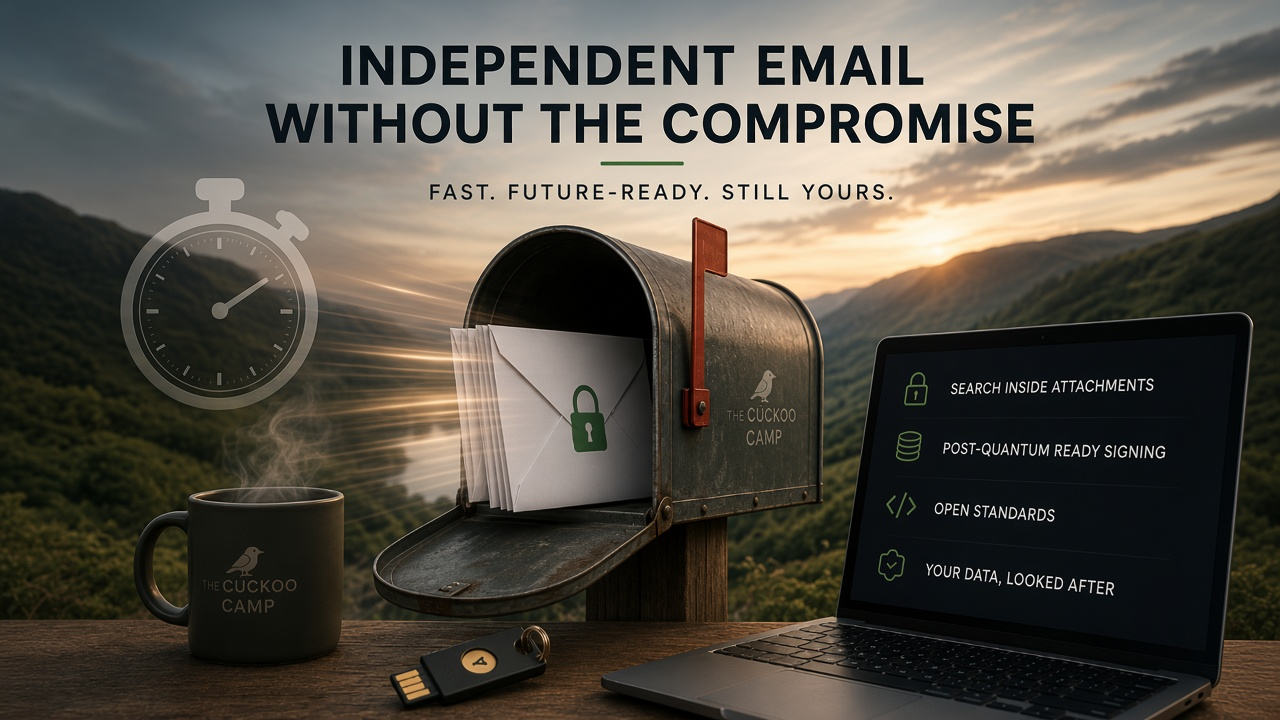
There's a quiet assumption that choosing independent email means accepting a little less — a bit slower, a bit behind, a compromise made for the sake of principle.
In August I wrote about taking back control of email: why The Cuckoo Camp runs its own mail platform rather than reselling Microsoft or Google, and how we rebuilt it around open standards without taking the service down.
One question I still hear is whether independent email can really keep up.
It’s a fair question. This week gave it a rather good answer.
On 26 October, Stalwart — the open-source mail and collaboration server at the heart of our platform — released version 1.0. Our platform has moved to it.
What “1.0” means here
In some software, 1.0 is the first version anyone should rely on.
Stalwart isn’t that kind of project. It has been in continuous development for five years and was already running production mail for organisations and service providers long before this release — including the platform described in our previous article.
What 1.0 marks is a set of promises.
The Stalwart team spent this release on two things: making every part of the server as fast as it could be and proving it with published numbers, and finalising the way data is stored so that, from now on, upgrading means installing a new version and nothing more.
The first is the headline. The second, for anyone trusting a provider with their mail, matters at least as much.
The numbers — and whose numbers they are
Let me be completely clear about this part: these are not our figures.
They come from Stalwart’s own benchmark lab, published alongside the release. The team compared Stalwart 1.0 with Postfix 3.11 and Dovecot 2.4 — the combination that sits underneath most self-hosted email on the internet, including popular packages such as mailcow, docker-mailserver and Mail-in-a-Box.
Both ran on identical cloud servers (8 AMD EPYC vCPUs, 32 GiB of memory, local NVMe storage), loaded with the same 1,000 mailboxes plus three very large ones, and were given exactly the same work.
According to Stalwart’s results:
- Stalwart was faster in 35 of 38 head-to-head comparisons.
- Signing in, including a full encrypted handshake, took 5.1 ms instead of 28 ms.
- It was faster in 14 of 15 everyday mail-app operations, by 1.4 to 19 times.
- It accepted 5,445 incoming messages per second, against 723.
- A newly delivered message became visible to a mail app 16 times sooner, and an app waiting for new mail was told about it in 3.3 ms rather than half a second.
- On a mailbox of 250,000 messages, a full-text search of every message took 3.75 ms instead of 136 ms, and moving or deleting 25,000 messages took about a tenth of a second instead of 24 to 34 seconds.
The three tests it lost were all the same operation: marking every message in a mailbox as read at once.
I rather like that they published that.
On the strength of these results, Stalwart’s developers now say plainly that it is “the fastest mail server on the planet”. That is their claim, about their test lab. What gives it weight is that every script, configuration and raw result is public, along with a frank list of caveats, so anyone can rerun the tests and check.
Our platform runs on different hardware, sized for the organisations we support, and it isn’t handling anything like five thousand messages a second. Nobody should expect to see those figures on their own account. Your connection, your device and your mail app will always have more effect on how quick things feel than the server’s peak throughput.
So why does any of this matter?
Why speed matters to a small provider
Not because anyone needs five thousand messages a second.
It matters because a server that does the same work with less effort has more in reserve for the moments that count — the Monday morning when everyone opens their inbox at once, the summons going out to the whole Lodge, the creator whose inbox fills up after a campaign goes live.
It matters because the gap grows with the size of the mailbox. People keep email for years. A Lodge Secretary’s archive, a charity’s correspondence, the inbox holding every brand deal a creator has ever done — those are exactly the mailboxes that conventional systems tend to slow down on. Search that stays quick at a quarter of a million messages means keeping your history doesn’t come with a penalty.
It matters because new mail can reach your phone almost as soon as it arrives.
And it matters because efficiency is what lets a small, independent provider offer a serious service at a fair price, without cutting corners elsewhere.
The part that matters more: your data
Speed makes the headline. What I care about most is what happens to the mail we look after.
Stalwart 1.0 finalised its storage format. That sounds dry, but it means future releases upgrade in place. Fewer migration events means less risk, and it means security fixes and improvements can be applied promptly because nothing large stands in the way.
Getting to that point did require one careful move, and we treated it the way we treat everything involving client data:
- No big-bang switchover. The bulk of the data was copied while the existing service carried on running normally. Later passes copied only what had changed, so the final switch was short.
- An untouched original throughout. The existing data was only ever read during the move, never altered, so a complete copy remained available until the new system had proved itself.
- Nothing for your devices to redo. Message and folder identifiers were preserved, so phones and laptops carried on as before rather than downloading entire mailboxes again.
That’s the same principle we followed when the platform was first rebuilt: mail keeps flowing while the infrastructure underneath it improves.
Moving to a faster engine was only worth doing if nobody’s mail was put at risk to get there.
When even we shouldn’t be able to read it
Looking after someone’s mail isn’t only about keeping it safe and quick to reach. It’s also about deciding who can read it.
The platform supports end-to-end encrypted email using S/MIME and OpenPGP, the two established standards. A message encrypted by its sender stays encrypted until its recipient opens it. We store it exactly as it arrived, and we have no way to read it.
For mailboxes that need it, encryption at rest goes a step further. Every message the mailbox receives is encrypted with its owner’s own public key before it is stored. The matching private key never comes anywhere near our servers: it stays in the owner’s mail app. Stored mail can’t be read by anyone who gets hold of the server’s storage or a backup — and that includes us.
It isn’t the right choice for every mailbox, and it’s worth being straightforward about why:
- Messages are encrypted as they are stored, so they arrive in readable form. That’s what allows spam filtering and mail rules to keep working.
- Senders, recipients, subjects and dates stay readable, so mail can still be listed and sorted.
- Search can no longer look inside the body or attachments of encrypted messages.
- It applies to mail stored after it is switched on, and it needs a mail app that supports S/MIME or OpenPGP and holds your private key, such as Thunderbird, Outlook or Apple Mail.
For a Lodge Almoner handling welfare matters, or a business holding confidential client information, that trade can be well worth making. For a busy shared inbox, full search is probably worth more.
Either way, it’s a choice made per mailbox, with our help — not one made for you.
Cutting edge, not bleeding edge
Being early to good technology is one of the advantages of not being a vast platform with a product roadmap set elsewhere. Alongside the performance work, Stalwart 1.0 brings some genuinely forward-looking capabilities:
- Search inside attachments. Full-text search now covers the text of attached PDF, Word, Excel, PowerPoint, OpenDocument, EPUB and RTF files, so a search can find the contract attached to last year’s message, not just the message that mentions it. The rewritten search engine also handles proper phrase searches. Scanned documents with no text layer, password-protected files and older Office formats such as .doc and .xls aren’t covered. The text extractor was written from scratch with strict limits, so a malicious or malformed file can’t overwhelm the server.
- Post-quantum-ready signing. Stalwart reports being the first mail server to implement DKIM2 and DMARCbis, the next generation of the standards that prove a message really came from your domain. Version 1.0 adds support for signatures designed to resist attack by future quantum computers. Adoption across the wider email world is still at an early stage, but the platform is ready for it.
- Modern sign-in. Support for the emerging OAuth standard that lets any compliant mail app sign in to any compliant mail server securely, which major mail apps are now beginning to adopt.
- Memory-safe foundations. Stalwart is written in Rust, a language designed to rule out a whole class of memory-handling errors that have historically been behind many serious security vulnerabilities in internet software.
- Testing that continues. The release went through a stress-testing lab running hundreds of processors across dozens of regions, with six-hour soak tests and more than ten million messages pushed through. Two rounds of testing found and fixed nearly a hundred problems before release, and every future release goes through the same process.
None of this was adopted because it was new. It was adopted because it was ready.
Still just email
For all of that, nothing about how you use your email has changed.
IMAP, SMTP, JMAP, CalDAV and CardDAV are all still there. Outlook, Apple Mail, Thunderbird, your phone’s built-in mail app and our webmail all carry on working exactly as before.
That’s deliberate. A faster engine is only an improvement if it doesn’t come with a new set of locks attached.
What this means for our clients
In practical terms: nothing for you to do.
Your mail is running on a faster, more efficient engine, built on a storage foundation designed to last, with search that reaches inside your attachments and some capabilities that most of the industry is still catching up with. Where a mailbox needs it, the option is there for mail that even we can’t read. And you can still speak to someone who knows exactly how it’s put together.
The benchmarks are Stalwart’s, and full credit goes to their team for the work behind them. The care taken with your data is ours.
Independent email used to mean accepting a compromise.
It doesn’t any more.
Update history
- 29 October 2026 — Added a section on end-to-end encryption and encryption at rest, including the trade-offs, and clarified what attachment search does and doesn’t cover.
- 28 October 2026 — First published.
Modern, independent email — on your own domain.
Whether you're on Microsoft 365, Google Workspace or a collection of personal accounts, we can talk through what moving to an independent platform would actually involve.